
- Report year:2026
- Report author: Maria Ezpeleta and Ege Tekinbas
- Organisation: IGF Intergovermental Forum on Mining, Minerals, Metals and Sustainable Development
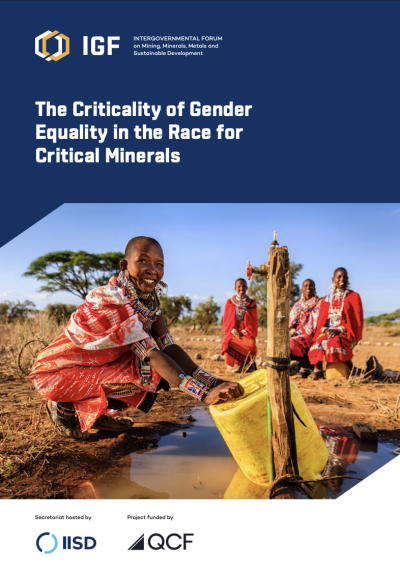
This IGF report, developed in partnership with the ILO and the UNDP, examines how the expansion of critical mineral extraction can affect women’s rights, particularly for Indigenous women, rural women, and women living in mining-affected communities. It looks at how environmental impacts, the location of mineral reserves, and accelerated permitting processes can increase risks related to land, livelihoods, food security, health, unpaid care work, safety, employment, consultation, and benefit sharing.
The report also identifies practical actions for governments and mining companies to make critical minerals governance more gender-responsive. These include integrating intersectional gender analysis into impact assessments, ensuring inclusive consultation and women’s meaningful participation, respecting free, prior, and informed consent, and establishing benefit-sharing mechanisms that expand women’s access to decent work, compensation, community development, and economic opportunities.
By placing gender equality at the centre of critical minerals governance, the publication argues that the transition to a low-carbon and digital future can become an opportunity to advance women’s rights, strengthen accountability, and support more inclusive and sustainable mineral development with gender-responsive policies in place.
The report also identifies practical actions for governments and mining companies to make critical minerals governance more gender-responsive. These include integrating intersectional gender analysis into impact assessments, ensuring inclusive consultation and women’s meaningful participation, respecting free, prior, and informed consent, and establishing benefit-sharing mechanisms that expand women’s access to decent work, compensation, community development, and economic opportunities.
By placing gender equality at the centre of critical minerals governance, the publication argues that the transition to a low-carbon and digital future can become an opportunity to advance women’s rights, strengthen accountability, and support more inclusive and sustainable mineral development with gender-responsive policies in place.